


Description
PrymaLab · Research Use Only
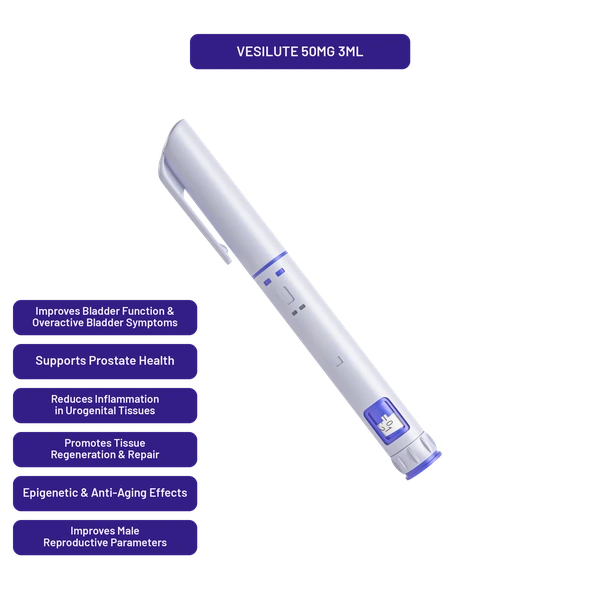
Preloaded Autoinjector | Vesilute | 3ml Pen | 50mg
Short acidic peptide in solution · 3ml at 50/3 mg/ml · No reconstitution step
The Vesilute pen is a preloaded 3ml research autoinjector holding a short acidic peptide in solution at 50/3 mg/ml, giving 50mg in the device. The compound differs from every other item in this catalogue in one respect: no primary source establishes which molecule the name refers to, and the two candidates in circulation differ by 128 daltons.
Specification Table
| Property | Value |
|---|---|
| Device format | Preloaded autoinjector pen, glass cartridge |
| Fill volume | 3 ml |
| Concentration | 50/3 mg/ml |
| Total compound in device | 50 mg |
| Molar concentration | Depends on identity: 50 x 1.271 mM if Glu-Asp, 50 x 0.854 mM if Lys-Glu-Asp |
| Compound | Vesilute. Vendor trade name; no primary literature, no Khavinson publication and no regulatory record uses it |
| CAS number | Unverified. No registry number exists for either candidate under this name |
| Molecular formula | Unverified. C9H14N2O7 if Glu-Asp; C15H26N4O8 if Lys-Glu-Asp |
| Molecular weight | Unverified. 262.22 average and 262.0801 monoisotopic for Glu-Asp; 390.39 and 390.1751 for Lys-Glu-Asp |
| Amino acid sequence | Unverified. Vendors state either H-Glu-Asp-OH (ED, two residues) or H-Lys-Glu-Asp-OH (KED, three residues); the latter is the verified sequence of Vesugen |
| Solution appearance | Clear and colourless |
| Reconstitution required | None. Supplied as solution |
| Excipient system | Not published on the product record. Confirm against certificate of analysis |
| Solution pH | Not published on the product record |
| Storage | 2-8°C, protected from light, do not freeze |
| Light sensitivity | Low. Neither candidate has a chromophore above 230 nm; light protection guards only against photosensitised impurity chemistry |
| Solution stability | No study exists for any compound sold under this name |
| Cyclisation routes | N-terminal pyroglutamate (mass loss 18 Da) if Glu-Asp; diketopiperazine closure for either candidate |
| Identity test | One mass measurement settles it: [M+H]+ 263.09 for Glu-Asp against 391.18 for Lys-Glu-Asp |
| Salt form | Acetate or TFA per vendor claim, unverified. Not stated on the product record |
| Purity | Per lot-specific certificate of analysis |
| Regulatory status | No approval anywhere. Not a medicine under FDA, EMA, PMDA, TGA, Health Canada or the Russian Ministry of Health. Not on the WADA 2026 Prohibited List. Not on the FDA 503B category lists of 21 March 2025 and not eligible under section 503A |
What Is Actually in the Vesilute Pen?
Nobody selling this compound can produce a primary source for its sequence, and the two candidates in circulation are different molecules with different masses and different chemistry. That is the first thing a certificate of analysis has to settle.
The scale of the gap is worth stating plainly. Khavinson’s own publication list contains no title under this name. The 2021 systematic review in Molecules, which tabulates the short peptides attributed to that school, lists Vilon (KE), Thymogen (EW), Epitalon (AEDG), Cartalax (AED), Vesugen (KED), Pinealon (EDR), Bronchogen (AEDL), Cardiogen (AEDR) and Testagen (KEDG). No bladder peptide appears in it. PubMed returns nothing. No regulatory document in any jurisdiction uses the name.
What circulates instead are two vendor assignments. The first is Glu-Asp, a dipeptide of 262.22 Da, which is what this site’s own lyophilized vial listing states. The second is Lys-Glu-Asp, a tripeptide of 390.39 Da. The problem with the second is that Lys-Glu-Asp is the verified sequence of Vesugen, the Khavinson vascular peptide, confirmed in the group’s 2022 paper in Cells. If the tripeptide assignment is correct, then this product is a relabelled Vesugen with a different organ attached to the marketing.
Neither assignment has a primary source. One published vendor research page compounds the confusion by giving “approximately 246 Da” for Glu-Asp, which is arithmetically wrong by 16 daltons.
The practical consequence is not academic. The two candidates differ by 1.49-fold in molarity at equal mass, so every dilution calculation from this device produces a different answer depending on which molecule is inside. They also have different chemistry: the dipeptide has a free N-terminal glutamate that can cyclise, the tripeptide does not. A single mass measurement resolves it, and until that measurement exists the honest description of the contents is a short acidic peptide of unconfirmed sequence. The bioregulator research overview and this site’s background article set out what the wider family looks like.
What Changes When This Peptide Ships in Solution?
Both candidates are short, acidic and non-aromatic, so the dominant solution-state fact is the same for either: there is nothing to oxidise and nothing to photolyse, and the only intrinsic routes are cyclisation reactions.
Neither molecule contains asparagine, glutamine, methionine, tryptophan, tyrosine, histidine or cysteine. That removes amide deamidation, methionine sulfoxide formation, indole photo-oxidation and every kind of disulfide chemistry at a stroke. Compared with the tryptophan-bearing peptides in this range, the degradation map is nearly empty.
If the compound is Glu-Asp, the live route is N-terminal cyclisation. Glutamic acid at a free N-terminus closes to pyroglutamate with loss of 18 Da, giving pGlu-Asp, and Chelius and colleagues showed in 2006 that phosphate and citrate buffers accelerate exactly this reaction. The product is N-blocked and no longer the parent molecule. Notably, the aspartate sits at the C-terminus, which means the succinimide route that makes Asp-Gly sequences so unstable is unavailable here: that reaction needs a following backbone nitrogen, and there is none.
If the compound is Lys-Glu-Asp, the pyroglutamate route disappears because the N-terminal residue is lysine. In its place comes a different vulnerability: the lysine epsilon-amine forms adducts with reducing sugars or aldehydic impurities, so a formulation containing any sugar excipient is a formulation with a slow Maillard reaction in it. A diketopiperazine route also exists, closing cyclo(Lys-Glu) and releasing free aspartate.
Diketopiperazine closure applies to the dipeptide as well. Goolcharran and Borchardt measured this reaction class in 1998 and placed free-acid peptides at pH 4 to 6 among the slower cases, well behind esters and amides. No rate has been measured for either candidate specifically.
No forced-degradation or shelf-life study has ever been published for a compound sold under this name, or for Glu-Asp as a pharmaceutical substance, and there is no approved product whose formulation choices would reveal what a sponsor thought the risks were.
What Does the Vesilute Pen Deliver Per Increment?
Concentration is 50/3 mg/ml and mass per increment is fixed regardless of identity, but molarity is not, which is the one place the unresolved sequence changes the arithmetic on the bench.
Mass per 0.01 ml, the smallest increment on an insulin-graduated barrel, is 50 multiplied by 3.33 microgram; per 0.1 ml it is 50 multiplied by 33.3 microgram. At a 10 mg fill that is 3.33 mg/ml, 33.3 microgram per increment and 333 microgram per 0.1 ml.
Molarity forks. On the Glu-Asp assignment the concentration is 50 multiplied by 1.271 mM, so a 10 mg fill is 12.7 mM. On the Lys-Glu-Asp assignment it is 50 multiplied by 0.854 mM, so the same fill is 8.5 mM. Anyone working in molar units from this device is carrying a 1.49-fold uncertainty until the identity is settled. The dilution calculator handles the arithmetic once the molecular weight is known.
There is no published in vitro concentration for this compound to compare against, because there is no published work on it. For orientation only, Khavinson-group cell-culture experiments with other short peptides are commonly reported at 10 to 100 ng/ml, which for a 262 Da dipeptide is roughly 0.04 to 0.4 micromolar. Reaching 0.1 micromolar from a 12.7 mM stock is a 127,000-fold dilution.
Vesilute Pen vs Vial: What the Format Settles
On the vesilute pen vs vial question the format is the smaller variable, because the identity gap sits upstream of both and is unaffected by either.
A pen fixes concentration at manufacture and removes reconstitution error. The pen versus vial comparison and the preloaded autoinjector category page lay out that general case in full.
The compound-specific reading is unusual. For most peptides a solution format trades convenience against a degradation clock that starts at the fill line. Here the clock runs slowly: there is no oxidisable residue, no chromophore and no fast hydrolytic motif, so the intrinsic chemistry is about as quiet as a peptide solution gets. That makes the pen a reasonable format on chemical grounds alone, and it is why the answer to whether does vesilute come in a pen is less interesting than the answer to what is in it.
Where the vial keeps an advantage is analytical. A dry cake can be weighed, dissolved to a known concentration and characterised before any of it is used. Given that the sequence is unconfirmed, that matters more here than the reconstitution variability the pen removes. On the vesilute pen vs vial trade-off, the pen wins on consistency and the vial wins on finding out what the material is.
What the Product Record Does Not State
The list is longer for this compound than for anything else in the catalogue, and it starts with the identity rather than the formulation.
The sequence is not stated with a source. Whether the device holds a dipeptide or a tripeptide changes the molar concentration, the cyclisation chemistry and, if the tripeptide assignment is right, the name the material should be sold under.
The excipient system is unpublished. That matters in two specific ways here: phosphate and citrate accelerate N-terminal glutamate cyclisation on the dipeptide assignment, and any sugar excipient opens a Maillard route on the tripeptide assignment. The buffer question therefore cannot even be asked properly until the sequence is known.
Solution pH is unpublished, salt form is unpublished, and no fill date or in-use stability figure is given. Gaps of that kind are ordinary in research-format products; what is not ordinary is that they sit on top of an unresolved identity rather than beside a confirmed one.
Verifying the Vesilute Pen and Confirming Its Contents
One mass measurement answers the question that everything else on this page depends on: [M+H]+ at 263.09 means Glu-Asp, and 391.18 means Lys-Glu-Asp.
That experiment needs only a small volume drawn from the device, diluted and run on any electrospray instrument, and it is worth doing on receipt rather than after an unexplained result.
Routine purity work is harder than usual because neither candidate has an aromatic residue. There is no absorbance at 280 nm and nothing above 230 nm to detect, so ultraviolet quantification of the kind used for tryptophan-bearing peptides is unavailable. HPLC purity has to run at 210 to 220 nm, where the peptide bond absorbs weakly and where buffer components, residual solvents and the acetate or trifluoroacetate counter-ion all interfere. Charged-aerosol or evaporative light-scattering detection is the alternative and gives a more honest mass-based purity figure.
For the degradation routes, a mass shift of exactly 18 Da downward indicates cyclisation, whether to pyroglutamate or to a diketopiperazine, and those two products are isobaric so the chromatography rather than the mass identifies which. Inspect the solution against a white background before each draw: it should be clear and colourless with no particulate. Let the device reach ambient temperature before actuating, because cold solution is more viscous and viscosity shifts delivered volume in a spring-driven mechanism.
What the Literature Actually Reports About This Compound
Nothing has been published on a compound named Vesilute: no human trial, no animal study, no pharmacokinetics, no toxicology, no stability work and no primary source for the sequence.
The study most often cited in its support concerns a different product entirely. Kovalev and colleagues published in Urology Herald in 2024 a prospective, uncontrolled cohort of 20 women with idiopathic overactive bladder, each given ten intramuscular injections of Vezusten. Reported changes were daily voids from 14.0 to 11.0, maximum cystometric capacity from 267 to 320 ml, the OAB-q score from 28 to 19 and nocturia episodes from 4 to 2, with no adverse events reported. There was no control group and no trial registration.
Vezusten, also written Vesusten, is a Russian prescription medicine: a lyophilisate of bovine urinary-bladder polypeptides, 5 mg per vial with glycine as the only excipient, reconstituted in 1 to 2 ml of water or saline for intramuscular injection, manufactured by Samson-Med in St Petersburg with a registration valid to 29 April 2026. It is an undefined tissue extract from cattle. It has no sequence, no molecular weight and no synthetic identity, and the Kovalev paper never mentions Vesilute. Data from one cannot transfer to the other.
The Khavinson framework proposes that short acidic peptides enter cells and interact with DNA and histones to alter transcription. The 2021 review places Lys-Glu-Asp among peptides said to affect neuronal differentiation and attributes nothing to Glu-Asp or to any bladder peptide. Rodent bladder-tumour work in that group’s record used Vilon and Epithalon, different molecules in an oncology model.
Absence of adverse findings here is a consequence of absence of studies, not a safety observation.
Vesilute Pen Storage and Solution Stability
Vesilute pen storage is 2-8°C, protected from light, and never frozen, and all three instructions rest on general practice rather than on any compound-specific measurement.
Refrigeration slows the cyclisation routes, which are the only intrinsic chemistry either candidate has. Light protection is precautionary rather than mechanistic, since neither molecule absorbs above 230 nm; it guards against photosensitised chemistry driven by impurities or excipients rather than by the peptide itself. This is one of the few compounds in the range where an amber cartridge really is a formality. Freezing remains prohibited because freeze-concentration raises local solute concentration and shifts pH in the shrinking unfrozen fraction, which is the condition that accelerates both pyroglutamate formation and diketopiperazine closure.
Published vesilute solution stability data does not exist, and no honest reading of the record can produce a shelf-life figure. Keeping the solution mildly acidic, around pH 4 to 6, and away from phosphate and citrate is the reasoning that follows from the chemistry of the candidates rather than from measurement. Any statement about vesilute solution stability at a research fill strength is inference, and it should be recorded as such alongside the fill date, the date of first actuation and cumulative time out of refrigeration.
What Is the Safety and Regulatory Position?
No product named Vesilute is approved by any regulator, and the compound has never been assessed by one.
The FDA, EMA, PMDA, TGA, Health Canada and the Russian Ministry of Health have authorised nothing under this name. Khavinson-affiliated firms sell short peptides in Russia as dietary supplements, and whether a supplement registration exists under this particular name is unverified. Vezusten, the bovine bladder extract, is a Russian prescription medicine and a separate product with a separate registration.
The compound is not named on the WADA 2026 Prohibited List, where no class covers an acidic di- or tripeptide without demonstrated hormonal activity. It does not appear on the FDA 503B category lists published 21 March 2025, has no USP monograph and is not an approved-drug component, so it is not eligible under section 503A. No FDA warning letter or import alert naming it was located.
Because no controlled study of any kind exists, there is no safety profile to report, no characterised adverse-effect list and no dose-response information. The absence of reported adverse events in the Kovalev cohort concerns 20 women given a bovine tissue extract, not this molecule. This is laboratory research supply, and the contents must not be administered to any human or animal.
What Are the Named Claims Attached to This Compound?
They belong to the urinary and reproductive tissue group in the Khavinson peptides scheme, and they arrive with the trade name rather than with any published study of it. Vendors describe the Vesilute peptide, sold as a Vesilute 20mg vial or in this pen, as acting on bladder function and on the urinary tract, and place it alongside Prostamax and Vesugen as a set covering the urinary system and the prostate gland. That set assignment is the source of the prostate health, prostate enlargement and sperm quality vocabulary that surrounds the name.
None of it has a primary source under this name. Benign prostatic hyperplasia is a defined clinical condition with approved treatments and no research peptide among them, and no study has tested any compound called Vesilute against it. Reports of tissue regeneration and tissue repair in this family come from work on other, identified sequences, and reading them across to an unidentified molecule is not a defensible step. The tissue repair literature that does exist for short peptides is mostly BPC-157’s, which is a different compound entirely with a different sequence, a different origin and a far larger rodent record. Nothing about the BPC-157 record transfers to a molecule whose sequence is unknown.
The word bioregulator is doing a lot of work here. In Khavinson’s usage a bioregulator is a short peptide assigned to an organ and proposed to act on gene expression in it, sometimes through interaction with DNA and with histone proteins in chromatin. Cytomedines is the older term from the same programme, used for the tissue extracts that preceded the synthetic peptides. Both words describe a research framework, not a demonstrated mechanism, and neither identifies which molecule is in this device.
What Would It Take to Verify a Vesilute 20mg Lot or This Pen?
One mass measurement settles the identity question, and it should be demanded before anything else. Glu-Asp, the synthetic dipeptide candidate, has an average mass of 262.22. Lys-Glu-Asp has 390.39. Those two figures are 128 daltons apart, which no analytical method could confuse, so a single accurate-mass result on the actual fill resolves what no vendor description currently does. Aspartic acid appears in both candidate sequences, so composition alone does not separate them.
Ask for a lot-specific CoA that states the sequence it tested against, not a representative document. A certificate that reports purity without naming the target molecule is reporting the purity of something unspecified. Where a supplier says the material has been tested independently, ask which laboratory, which method and against which reference standard, because testing an unidentified compound produces an unidentified result. This is the one item in this catalogue where the CoA is not a formality.
Format matters here too. A Vesilute 20mg vial ships as a lyophilized powder and is brought into solution with bacteriostatic water by the purchaser, and the volume of bacteriostatic water added is what sets the concentration, so the concentration is set at the bench and the dry material can be stored while the identity question is resolved. This pen is already in solution at 50/3 mg/ml, which fixes the concentration and starts the stability clock at a fill date the product record does not state. Freeze-drying protects a compound that has not been characterised; a solution does not. Research protocols built on this device should record the lot and the arrival date at minimum, and research applications that depend on knowing the molar concentration cannot proceed until the identity is settled, since the two candidates differ by fifty per cent in molarity at the same mass concentration.
Published Literature
The entries below were confirmed against publisher records while this page was researched. Read the first and last of them for what they do not contain: neither names a bladder peptide.
- Khavinson VK, Popovich IG, Linkova NS, et al. Peptide regulation of gene expression: a systematic review. Molecules. 2021;26(22):7053. DOI: 10.3390/molecules26227053
- Khavinson V, Linkova N, Dyatlova A, et al. Senescence-associated secretory phenotype of cardiovascular system cells and inflammaging: perspectives of peptide regulation. Cells. 2022;12(1):106. DOI: 10.3390/cells12010106
- Kovalev GV, Labetov IA, Shakirova RR, et al. The peptide regulator Vezusten in the management of overactive bladder syndrome: an efficacy evaluation. Urology Herald. 2024;12(4):50-56. DOI: 10.21886/2308-6424-2024-12-4-50-56
- Chelius D, Jing K, Lueras A, et al. Formation of pyroglutamic acid from N-terminal glutamic acid in immunoglobulin gamma antibodies. Analytical Chemistry. 2006;78(7):2370-2376. DOI: 10.1021/ac051827k
- Goolcharran C, Borchardt RT. Kinetics of diketopiperazine formation using model peptides. Journal of Pharmaceutical Sciences. 1998;87(3):283-288. DOI: 10.1021/js970325m
- Khavinson VKh, Kuznik BI, Ryzhak GA. Peptide bioregulators: a new class of geroprotectors. Message 1: results of experimental studies. Advances in Gerontology. 2013;3(3):225-235. DOI: 10.1134/S2079057013030065
Frequently Asked Questions
What is the Vesilute pen?
A preloaded 3ml research autoinjector holding a short acidic peptide in solution at 50/3 mg/ml, giving 50mg in the device. No reconstitution is needed. The sequence is not established by any primary source, so the identity should be confirmed by mass before quantitative work.
Does Vesilute come in a pen?
As a research preparation, yes, and this device is one. As an approved medicine, no: nothing under this name is registered anywhere, in any format. The Russian bladder medicine sometimes cited alongside it, Vezusten, is a 5 mg lyophilised bovine tissue extract in a vial, not a synthetic peptide pen.
Which molecule is actually in the device?
Unresolved. Two vendor assignments circulate: Glu-Asp, a dipeptide of 262.22 Da, and Lys-Glu-Asp, a tripeptide of 390.39 Da. Neither has a primary source. The tripeptide is the verified sequence of Vesugen, so that assignment would make this a relabelled product rather than a distinct one.
How would the identity be settled?
One electrospray mass measurement. The protonated molecular ion appears at 263.09 for Glu-Asp and at 391.18 for Lys-Glu-Asp, a 128 dalton separation that no instrument could confuse. It needs only a small volume drawn from the device and is worth running on receipt rather than after an unexplained result.
Why does the sequence change the arithmetic?
Because molarity depends on molecular weight while mass per increment does not. On the dipeptide assignment concentration is 50 multiplied by 1.271 mM; on the tripeptide assignment it is 50 multiplied by 0.854 mM. That is a 1.49-fold difference carried into every dilution calculated in molar units.
What does the device deliver per 0.01 ml increment?
The increment carries 50 times 3.33 microgram, and 0.1 ml carries 50 times 33.3 microgram. At a 10 mg fill that is 3.33 mg/ml and 33.3 microgram per increment, which is 12.7 mM on the dipeptide assignment or 8.5 mM on the tripeptide one.
What degrades in solution?
Only cyclisation. On the dipeptide assignment the N-terminal glutamate closes to pyroglutamate with loss of 18 Da, a reaction phosphate and citrate accelerate. Diketopiperazine closure applies to either candidate. There is no oxidation, no deamidation and no disulfide chemistry, because none of the reactive residues is present.
Is the aspartate a stability problem?
Not in this arrangement. The fast aspartimide route that destabilises Asp-Gly sequences requires a following backbone nitrogen to attack the side-chain carbonyl. In both candidates the aspartate sits at the C-terminus with nothing after it, so that route is structurally unavailable. The same residue elsewhere in a sequence would behave very differently.
How does the vesilute pen vs vial choice look?
The pen fixes concentration and removes reconstitution error; the vial allows the material to be weighed, dissolved to a known concentration and characterised before use. Given that the sequence is unconfirmed, that analytical access matters more here than it would for a compound with a settled identity.
What does vesilute pen storage require?
2-8°C, protected from light, never frozen. Refrigeration slows the cyclisation routes. Light protection is precautionary rather than mechanistic, since neither candidate absorbs above 230 nm. The freezing prohibition matters because freeze-concentration raises local solute concentration and shifts pH in the unfrozen fraction.
What is known about vesilute solution stability?
Nothing measured. No forced-degradation or shelf-life study exists for any compound sold under this name, and none exists for Glu-Asp as a pharmaceutical substance. Keeping the solution mildly acidic and away from phosphate and citrate follows from the chemistry of the candidates, not from data.
Why is purity harder to certify for this compound?
Because neither candidate has an aromatic residue, so there is no absorbance above 230 nm. HPLC purity must run at 210 to 220 nm where the peptide bond absorbs weakly and buffer components interfere, or rely on charged-aerosol or evaporative light-scattering detection for a mass-based figure instead.
What clinical evidence exists?
None under this name. The study usually cited, Kovalev and colleagues in Urology Herald in 2024, is an uncontrolled cohort of 20 women given ten intramuscular injections of Vezusten, a bovine bladder polypeptide extract. It reports no sequence and never mentions Vesilute, so its findings cannot be transferred.
What did that Vezusten study report?
Daily voids fell from 14.0 to 11.0, maximum cystometric capacity rose from 267 to 320 ml, the OAB-q score moved from 28 to 19 and nocturia from 4 to 2, with no adverse events reported in 20 women. There was no control group and no trial registration, and the product studied was a 5 mg bovine extract.
Has Khavinson published on this compound?
No. His publication list carries no title under this name, and the 2021 systematic review in Molecules tabulates nine short peptides without including a bladder one. Rodent bladder-tumour work in that group’s record used Vilon and Epithalon, which are different molecules in an oncology model.
What is the regulatory position?
Unapproved everywhere. No authorisation exists from the FDA, EMA, PMDA, TGA, Health Canada or the Russian Ministry of Health. The compound is not on the WADA 2026 Prohibited List, not on the FDA 503B category lists of 21 March 2025, has no USP monograph and is not eligible under section 503A.
What claims are attached to the Vesilute peptide?
Bladder function and urinary tract activity, by assignment within the Khavinson peptides scheme rather than from any study published under this name. The surrounding prostate health, prostate enlargement and sperm quality vocabulary comes from the same set assignment. Benign prostatic hyperplasia has approved treatments and no research peptide among them.
What does calling something a bioregulator actually mean?
In Khavinson’s usage, a short peptide assigned to an organ and proposed to act on gene expression there, possibly through DNA and histone proteins in chromatin. Cytomedines is the older term for the tissue extracts that preceded the synthetic peptides. Both name a research framework rather than a demonstrated mechanism, and neither identifies the molecule in this device.
How can the identity of this device be settled?
One accurate-mass measurement on the fill. The synthetic dipeptide candidate Glu-Asp has an average mass of 262.22 and Lys-Glu-Asp has 390.39, which is 128 daltons apart and impossible to confuse. Aspartic acid appears in both, so composition does not separate them. Ask for a lot-specific CoA that names the sequence it tested against.
Does third-party testing resolve the problem?
Not on its own. Where a supplier says material is third-party tested, ask which laboratory, which method and against which reference standard, because third-party testing of an unidentified compound returns an unidentified result. Research protocols using this device should record lot and arrival date, and research applications needing molar concentration cannot start until identity is settled, since the two candidates differ by half in molarity at the same mass concentration.
Compliance Statement
The Vesilute pen is sold exclusively for laboratory research use. It is not a drug, food, or cosmetic product, and it is not a dietary product of any kind. It is not approved by the FDA or any comparable authority for human or veterinary use. This product is not intended to diagnose, treat, cure, or prevent any disease. It must not be given to humans or animals. Purchase is restricted to qualified researchers and institutions operating within applicable laws. All handling is the responsibility of the purchasing laboratory.










Reviews
There are no reviews yet.